
Restore the latest snapshot
1
Open Restore
On the job in Selected Jobs, click Restore.
2
Leave the fingerprint empty
An empty Snapshot fingerprint means the latest snapshot.
3
Preview
Click Preview Restore. Scout shows how many files the snapshot has, and how many would replace existing files or be added.
4
Confirm
Click Restore These Files to write the files into the job’s folder. Search and the All, Replace, and Add filters only change what the preview shows. They don’t pick a subset to restore.
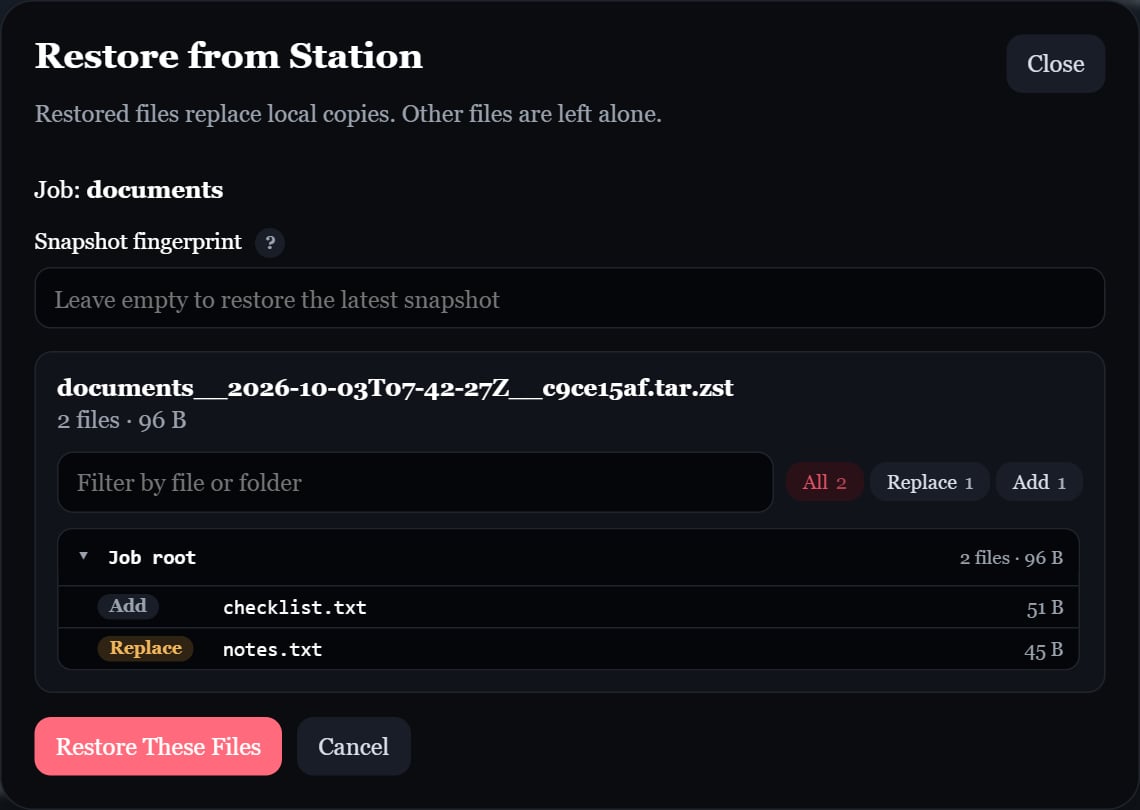
Restore preview showing one missing file to add and one local file to replace.
Restore a specific snapshot
Each snapshot’s fingerprint is part of its filename on Station, and is shown as FP next to each snapshot in Station’s UI:Requirements
- Scout must be able to reach Station, with a valid credential.
- Scout must have the same encryption key that encrypted the snapshot. If it doesn’t, the restore fails with “unable to decrypt snapshot with this Scout key”.
After you rotate the key, Scout can no longer restore snapshots made with the old key, and Station’s UI stops accepting the old key after Scout’s next upload. Download any older snapshots you need before rotating.
Rebuilding a lost machine
Scout only restores snapshots belonging to its own instance ID, which is stored inconfig/installation.id. A fresh install gets a new instance ID, so it can’t restore the old machine’s snapshots through Scout on its own.
If you have the old Scout’s whole config folder (it includes installation.id, encryption.key, and the saved settings and credential):
1
Put the config folder back
Place it next to
docker-compose.yml before starting Scout for the first time.2
Use the same Scout ID
Set
SCOUT_ID to the old value in .env.3
Recreate the job and restore
Create the job with the same job name, then use Restore.
encryption.key, download the snapshots from Station’s UI with that key, and extract them by hand: