
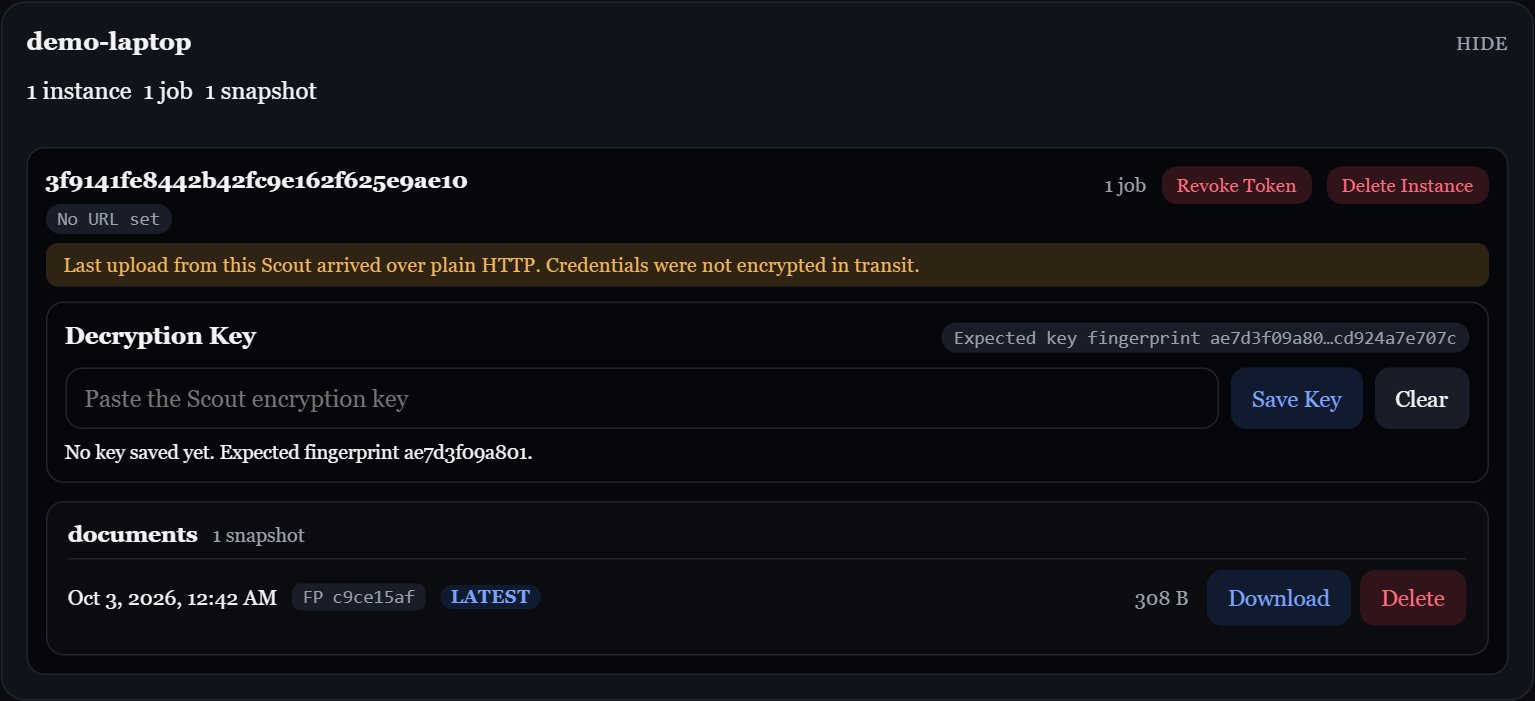
An expanded Scout instance with a stored snapshot in a local demo deployment.
How snapshots are stored
Each snapshot is one encryptedtar.zst file in Station’s backup folder:
Download a snapshot
Click Download on a snapshot. The first time, Station asks for that Scout’s encryption key.Your browser does the decrypting, so open Station over HTTPS or through
localhost. A plain HTTP address on your network won’t work.1
Copy the key from Scout
In Scout’s UI, find Encryption Key and click Copy. See Encryption key.
2
Paste it into Station
Paste it when Station prompts. Station checks it against the key fingerprint that Scout reported, so a wrong key is caught before decryption starts.
3
Save the file
The snapshot is decrypted in your browser as it downloads, and saved as a regular
tar.zst archive.Delete a snapshot
Click Delete on a snapshot and confirm. This permanently removes the file.Retention
After each upload, Station keeps the most recent snapshots for that job and Scout instance and deletes older ones. Keep Last Snapshots in Edit Station Settings sets how many (default3). Scout instances never prune each other’s snapshots, even if they share a SCOUT_ID.
Age is judged by each file’s modification time, so keep those times when copying archives back into the backup folder.
Unusual sizes
Station remembers the size of each job’s last 20 uploads. When a new archive is less than half or more than double the job’s usual size, and far outside its normal range, the snapshot gets an unusual size badge. Hover over it to see why, for example:This archive is 39.1 KB, but this job’s archives are usually about 979.0 KB.Station also sends an ntfy alert and passes the reason to the post hook. The check needs 5 earlier uploads and can be turned off with Unusual uploads in Edit Station Settings. Station only sees archive sizes, and by the time an archive arrives it has already left Scout, so it can flag but not hold. Scout’s own checks are stronger and can hold a backup before it uploads. See Unusual backups.
Integrity checks
Station can re-check stored snapshots with SHA-256 to catch files corrupted or changed on disk. Each check covers the latest snapshot of every job, not the full history.- Run Now: start a check from the integrity bar on the snapshots page.
- Scheduled: set Snapshot Integrity Check Interval (hours) in Edit Station Settings.
0turns scheduled checks off.
Station reads the check interval when it starts. After changing it, restart Station:
docker compose restart station.